Home Wind Turbines: How to Choose and Install
Introduction
Wind energy is the second most popular renewable energy source after solar. If your property is located in a windy region, a home wind turbine can be an excellent supplement or even the primary source of electricity. But unlike solar panels, wind turbines require a more careful approach to selection and installation.
In this guide, we’ll cover: which wind turbines are suitable for homes, how to calculate the wind potential of your site, how much it all costs, and which mistakes to avoid.
What Is a Home Wind Turbine
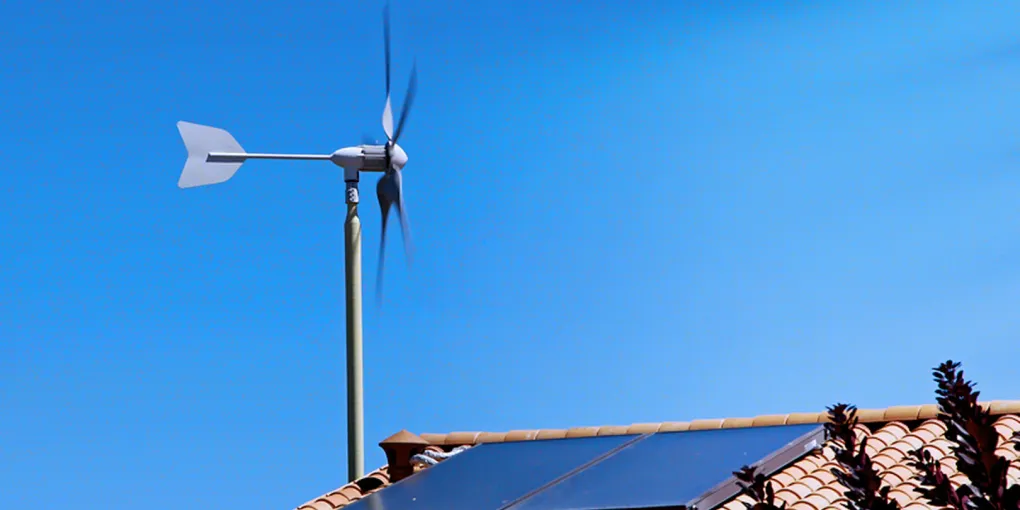
A home wind turbine (small wind turbine) is a device that converts the kinetic energy of wind into electricity. Unlike industrial wind turbines standing 80–150 meters tall, residential models range from 0.4 to 20 kW and are installed on towers 10–30 meters high.
The principle is simple: wind spins the blades, blades spin the generator, the generator produces electricity.
How It Works
A home wind turbine system consists of:
- Rotor with blades — captures wind and converts it into rotational motion
- Generator — converts rotation into electrical current (usually three-phase AC)
- Controller — rectifies the current and regulates battery charging, includes overvoltage protection
- Inverter — converts DC to AC 220V for household use
- Batteries — store energy (wind is inconsistent, a buffer is necessary)
- Tower — raises the turbine to a height where wind is more stable and stronger
Critically important: wind speed is the key factor. Wind energy is proportional to the cube of speed: when speed doubles, power increases 8 times. This is why tower height matters so much — at 20 m, wind can be twice as strong as at 5 m.
Main Types of Wind Turbines
By Axis of Rotation
| Characteristic | Horizontal-Axis (HAWT) | Vertical-Axis (VAWT) |
|---|---|---|
| Efficiency | 35–45% | 15–30% |
| Cut-in wind speed | 3–4 m/s | 1.5–3 m/s |
| Noise | Moderate | Low |
| Need for yaw mechanism | Yes | No |
| Maintenance | Moderate | Minimal |
| Price per kW | Lower | Higher |
| Best for | Open areas | Urban and turbulent zones |
Horizontal-Axis (HAWT)
The classic type — a “windmill” with 2–3 blades. Most efficient in steady wind from a consistent direction. Requires an orientation mechanism (tail vane) to turn into the wind.
Popular models: Ista Breeze i-2000, Rutland 1200, Whisper 200.
Vertical-Axis (VAWT)
Blades rotate around a vertical axis (like a carousel). Catch wind from any direction, work in light and turbulent wind. Types: Darrieus rotor (straight or curved blades) and Savonius rotor (scoop-type).
Advantage: ideal for locations with variable wind direction and built-up areas.
By Power Rating
| Class | Power | Application |
|---|---|---|
| Micro | 0.1–1 kW | Device charging, lighting |
| Small | 1–10 kW | Partial home power supply |
| Medium | 10–50 kW | Full power supply, farms |
Advantages and Disadvantages
Advantages:
- Energy generation day and night (unlike solar panels)
- Maximum output in winter and autumn — when there’s little sun
- Excellent complement to a solar system (hybrid setup)
- Long lifespan — 20–25 years
- Small installation footprint (vertical structure)
Disadvantages:
- Strong dependence on wind resources at the specific location
- Noise (30–55 dB, depends on model and wind speed)
- Vibration — requires proper tower foundation
- Need for a tall tower (from 15 m for effective operation)
- Maintenance of moving parts (bearings, blades)
- Possible height restrictions in residential areas
Comparison with Solar Panels
| Factor | Wind Turbine | Solar Panels |
|---|---|---|
| Works at night | Yes | No |
| Predictability | Low | Medium |
| Maintenance | Regular | Minimal |
| Winter output | High | Low |
| Noise | Yes | None |
| Cost per kWh | $0.04–0.10 | $0.03–0.06 |
| Payback period | 7–15 years | 5–8 years |
Best solution — a hybrid “wind + solar” system. In winter and at night, the turbine compensates for the drop in solar output, while in summer, solar takes on the main load.
Practical Applications
Assessing Wind Resources
Before purchasing, be sure to measure wind speed at your site. Use an anemometer at the planned installation height for at least 6–12 months.
Minimum requirements:
- Average annual wind speed from 4 m/s (below that — a wind turbine won’t pay for itself)
- Ideal speed: 6–8 m/s and above
- No large obstacles (buildings, trees) within a 150 m radius
You can also check wind maps for your region — they give a general picture but don’t replace local measurements.
Off-Grid Power Supply
A 3–5 kW wind turbine + 10–20 kWh batteries will cover basic household needs: lighting, refrigerator, pump, device charging. For full power supply (heating, water heater, electric stove), you need a 10–20 kW system or a hybrid setup.
Hybrid Wind + Solar System
Optimal configuration for maximum autonomy:
- Solar panels 3–5 kW (main output in summer)
- Wind turbine 2–5 kW (main output in winter and at night)
- Batteries 10–15 kWh (buffer)
- Hybrid inverter
This system provides stable output year-round.
Cost
| Component | Power | Cost |
|---|---|---|
| Wind turbine (horizontal) | 1 kW | $800–1,500 |
| Wind turbine (horizontal) | 3 kW | $2,000–4,500 |
| Wind turbine (horizontal) | 5 kW | $4,000–8,000 |
| Wind turbine (vertical) | 1 kW | $1,200–2,500 |
| Tower 15–20 m | — | $1,000–3,000 |
| Controller + inverter | — | $800–2,000 |
| LFP batteries 10 kWh | — | $3,000–5,000 |
| Installation and foundation | — | $1,500–4,000 |
Total for a 3 kW system: approximately $8,000–16,000 (with batteries).
Payback: with average wind of 5–6 m/s and a rate of $0.15/kWh — 8–12 years.
How to Choose a Wind Turbine
Step-by-Step Algorithm
- Measure the wind — install an anemometer for 6–12 months or study wind maps
- Determine consumption — analyze your electricity bills
- Choose the type — HAWT for open sites, VAWT for built-up areas
- Calculate power — keep in mind that a wind turbine delivers rated power only at rated wind speed (usually 11–12 m/s), average annual output is 15–30% of rated capacity
- Plan the tower — each additional 10 m of height increases output by 25–30%
- Check local regulations — height limits, noise restrictions, distance to neighbors
What to Look For When Buying
- Cut-in wind speed — the lower, the better (2–3 m/s for VAWT, 3–4 m/s for HAWT)
- Rated wind speed — at which rated power is delivered (usually 11–12 m/s)
- Survival speed — maximum wind it can withstand without damage (should be ≥ 50 m/s)
- Noise level — less than 40 dB at 20 m distance is a comfortable level
- Blade material — fiberglass (reinforced) is more reliable than plastic
- Generator type — permanent magnet (PMG) is the most efficient and reliable for small turbines
Common Beginner Mistakes
-
Installing at low height. A wind turbine on a two-story house roof (8 m) is a bad idea. Turbulence from the building destroys efficiency. Minimum — 15 m tower, optimal — 20–25 m.
-
Trusting nameplate power. Manufacturers state power at ideal wind of 11–12 m/s. Real average annual output is 15–30% of rated capacity. A “5 kW” wind turbine will average 0.75–1.5 kW.
-
Ignoring noise. Cheap turbines at wind speeds of 8–10 m/s create noticeable noise. Consider distance to bedrooms and neighbors. Minimum 30 m from living spaces.
-
Buying without wind measurements. The most expensive mistake. Without annual wind data for your specific site, you risk installing equipment that will never pay for itself.
-
Weak foundation and guy wires. The tower experiences enormous loads during gusts. Skimping on the foundation or guy wires can lead to collapse. Hire an engineer.
Future Developments
- Next-generation small turbines — bladeless (vibration) turbines like Vortex Bladeless: silent, no moving parts, but currently low efficiency
- Micro wind turbines for balconies — compact VAWTs with 100–500W output for urban apartments
- AI-powered smart controllers — operation optimization based on weather forecasts
- Cost reduction through 3D printing — blades and housings from composite materials
- Integration with home storage systems — pairing with Tesla Powerwall, BYD Battery, and similar products
FAQ
Which wind turbine is best for a vacation home? For a vacation home consuming 100–200 kWh/month, a horizontal-axis wind turbine of 1–2 kW on a 15 m tower is suitable. With average wind of 5 m/s, it will produce 100–150 kWh/month. Supplement with 1–2 kW of solar panels for stability.
Can you install a wind turbine in a city? Technically — yes (vertical-axis models are suitable). But be prepared for bureaucratic obstacles: height restrictions, neighbor approvals, noise regulations. In most cities, it’s easier to install solar panels.
How do you maintain a wind turbine? Once a year: inspect blades for damage, check and lubricate bearings (if not sealed), check tower guy wire tension, inspect electrical connections. Every 3–5 years: replace bearings.
Is a wind turbine noisy? It depends on the model and wind. Modern small HAWTs — 35–45 dB at 20 m distance (quiet conversation level). VAWTs — even quieter, 25–35 dB. At high wind speeds, noise increases.
Conclusion
A home wind turbine is not a universal solution. It’s economically viable only with an average annual wind speed of 4–5 m/s or higher at installation height. Before investing, measure the wind and calculate realistic output. The ideal option is a hybrid wind + solar system that provides energy generation at any time of day and year.