Solar Panels for Home: Complete Guide to Selection and Installation
Introduction
Solar energy is no longer exotic. In 2025, the cost of solar panels dropped by 90% compared to 2010, and millions of households worldwide already produce their own electricity. If you’re considering solar panels for your home, this guide will help you understand all the nuances: from panel types to payback calculations.
What Are Solar Panels
Solar panels (photovoltaic modules) are devices that convert sunlight energy directly into electricity. Each panel consists of dozens of photovoltaic cells — semiconductor wafers made of silicon. When photons of light hit the silicon, they knock electrons out of atoms, creating an electric current.
In simple terms: the panel “catches” sunlight and converts it into electricity that can power your refrigerator, lighting, computer, and any other appliances.
How It Works
A home solar power system consists of several components:
- Solar panels — installed on the roof or ground-mounted racks, generating direct current (DC)
- Inverter — converts direct current to alternating current (AC, 220V) used by household appliances
- Meter (bidirectional) — tracks generated and consumed grid energy
- Battery storage (optional) — stores excess energy during the day for nighttime use
- Charge controller — protects batteries from overcharging and deep discharge
During the day, panels generate electricity. If they produce more than the house consumes, the excess is either stored in batteries or fed back into the grid (if a net metering program is available).
Main Types of Solar Panels
| Type | Efficiency | Lifespan | Price per Watt | Best For |
|---|---|---|---|---|
| Monocrystalline | 20–24% | 25–30 years | $0.25–0.40 | Limited roof space |
| Polycrystalline | 15–20% | 20–25 years | $0.18–0.30 | Budget projects |
| Thin-film | 10–13% | 15–20 years | $0.10–0.20 | Non-standard surfaces |
| Heterojunction (HJT) | 22–26% | 25–30 years | $0.30–0.50 | Maximum efficiency |
Monocrystalline Panels
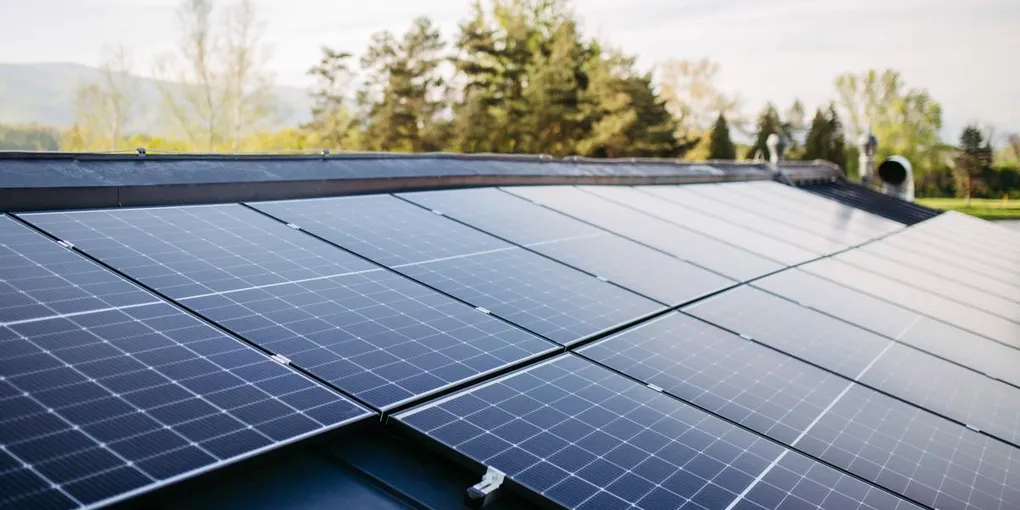
Made from a single silicon crystal. Recognizable by their uniform black color. The most popular choice for residential use thanks to high efficiency — you get more energy from the same roof area than with any other type.
Example: a 400W panel occupies about 1.7 m². For a 6 kW system, you’ll need 15 panels and ~25 m² of roof space.
Polycrystalline Panels
Made from multiple silicon crystals, which makes them cheaper. They have a characteristic blue mosaic tint. Efficiency is 3–5% lower, but the price compensates for this.
Thin-Film Panels
Flexible and lightweight, applied as a thin layer on a substrate. Suitable for curved surfaces, facades, and mobile installations. Lowest efficiency, but perform better in diffused light and high temperatures.
Heterojunction (HJT) Panels
The latest technology combining amorphous and crystalline silicon. Record efficiency in mass production, low temperature coefficient (less power loss in heat). Price is still higher but declining rapidly.
Advantages and Disadvantages
Advantages:
- Reduce electricity bills by 50–100%
- Energy independence from grid outages (with batteries)
- 25–30 year lifespan with minimal maintenance
- Silent operation — no moving parts
- Property value increase of 3–4%
- Carbon footprint reduction — 1 kW of capacity prevents ~1.5 tons of CO₂ per year
Disadvantages:
- High initial investment ($5,000–15,000 for an average household)
- Output depends on weather, season, and roof orientation
- Requires a sun-facing roof without shading
- Power degradation ~0.5% per year (after 25 years, a panel outputs ~87% of its initial capacity)
Comparison with Alternatives
| Parameter | Solar Panels | Wind Turbine | Diesel Generator |
|---|---|---|---|
| Initial cost | $5,000–15,000 | $3,000–20,000 | $500–3,000 |
| Energy cost | $0.03–0.06/kWh | $0.04–0.08/kWh | $0.20–0.40/kWh |
| Noise | None | 35–55 dB | 65–90 dB |
| Maintenance | Minimal | Annual | Constant |
| Payback period | 5–8 years | 7–12 years | Never pays back |
| Dependency | Sun | Wind | Fuel |
Solar panels win on the overall balance: predictable output, zero noise, minimal maintenance.
Practical Applications
Grid-Tied System (On-Grid)
The most popular option. Panels are connected to the grid through an inverter. During the day you use solar electricity, at night — from the grid. Excess is fed into the grid and offsets your nighttime consumption.
Suitable for: homes with reliable power supply where the goal is to reduce bills.
Off-Grid System
Completely independent from the grid. Requires batteries for energy storage. Suitable for remote homes where grid connection is impossible or costs more than a standalone system.
Suitable for: vacation homes, farms, houses in remote areas.
Hybrid System
Combines both approaches: connected to the grid but has batteries. When power goes out, the house continues running on stored energy.
Suitable for: areas with frequent power outages.
Cost and Payback
Approximate Calculation for a Home Using 300 kWh/month
| Component | Cost |
|---|---|
| Solar panels 6 kW (15 pcs. at 400W) | $3,000–4,500 |
| Grid-tie inverter | $800–1,500 |
| Mounting system and cables | $500–1,000 |
| Installation and commissioning | $1,000–2,000 |
| Total (on-grid) | $5,300–9,000 |
| Batteries 10 kWh (optional) | +$4,000–7,000 |
Average annual output of a 6 kW system: 7,000–9,000 kWh (depends on region).
Payback period: at a rate of $0.15/kWh — about 5–7 years. After that, electricity is essentially free for another 18–23 years.
How to Choose Solar Panels
What to Look For
- Panel wattage — standard for home: 380–450W per panel
- Efficiency — above 20% for monocrystalline (top models 22–24%)
- Temperature coefficient — the lower, the better (less power loss in heat). Good value: -0.30%/°C
- Power warranty — minimum 25 years (at least 80% of rated output)
- Product warranty — 12–15 years
- Certification — IEC 61215, IEC 61730
Top Manufacturers (2025–2026)
- LONGi — world’s largest, high quality
- JA Solar — excellent price/quality ratio
- Trina Solar — wide model range
- Canadian Solar — reliability confirmed by bankability
- REC Group — premium segment with record warranties
Common Beginner Mistakes
-
Underestimating shading. Even shadow from an antenna or chimney on one cell can reduce the output of the entire string by 30–50%. Conduct a shading analysis before installation.
-
Skimping on the inverter. The inverter is the heart of the system. A cheap no-name inverter will fail sooner and “eat” all your savings. Choose proven brands: Huawei, SMA, Fronius, Growatt.
-
Incorrect power calculation. Installing “by eye” without analyzing actual consumption and insolation leads to disappointment. Ask your installer for a calculation based on your bills from the last 12 months.
-
Ignoring tilt angle and orientation. Optimal tilt angle ≈ latitude of your location. South-facing orientation (in the northern hemisphere) is ideal. East/west deviation reduces output by 10–15%.
-
No monitoring. Without a monitoring system, you won’t know about problems in time. Modern inverters have Wi-Fi and an app — use them.
Future Developments
Solar energy continues to evolve:
- Perovskite panels — potential efficiency over 30% at low manufacturing cost. Expected in mass production by 2028
- Bifacial panels — collect reflected light from the back side, increasing output by 10–20%
- Building-integrated photovoltaics (BIPV) — solar tiles, facades, windows
- Falling battery prices — lithium iron phosphate (LFP) batteries are becoming more affordable, making standalone systems economically viable
FAQ
How many panels does an average home need? To cover consumption of 300 kWh/month, you need a 5–7 kW system — that’s 13–18 panels (at 400W each). The exact calculation depends on insolation in your region.
Do solar panels work in winter and cloudy weather? Yes. On a cloudy day, output is 10–30% of rated capacity. In winter — a 40–60% reduction due to shorter daylight hours. Annual output accounts for all seasons.
How long do solar panels last? Average lifespan is 25–30 years. Panels don’t “die” after the warranty period — their power just decreases. After 25 years, a panel outputs ~85% of its initial capacity.
Do panels need cleaning? In most cases, rain is sufficient. For heavy soiling (dust, bird droppings, pollen) — wash with water 2–4 times per year. Don’t use abrasives or harsh chemicals.
What happens during a power outage? If you have a grid-tied system (without batteries) — it will also shut down for safety reasons (to protect utility workers). With batteries or a hybrid inverter — the house continues running autonomously.
Conclusion
Solar panels are a proven technology with clear economics. With the right equipment selection and proper installation, the system pays for itself in 5–7 years and then provides essentially free electricity for another 18–23 years. Start by analyzing your consumption, assess your roof’s insolation, and contact several certified installers to compare proposals.