Home Battery Storage for Energy Independence: LFP, Lithium-Ion, and More
Introduction
Generating electricity from sun and wind is only half the challenge. The other half is storing that energy for use at night, in cloudy weather, or during grid outages. Home battery systems (Energy Storage Systems, ESS) solve exactly this problem.
Over the past 5 years, the cost of lithium batteries has dropped by 50%, and home batteries have gone from a niche product to a mainstream one. In this guide, we’ll cover battery types, capacity calculations, real costs, and common mistakes.
What Is a Home Battery System
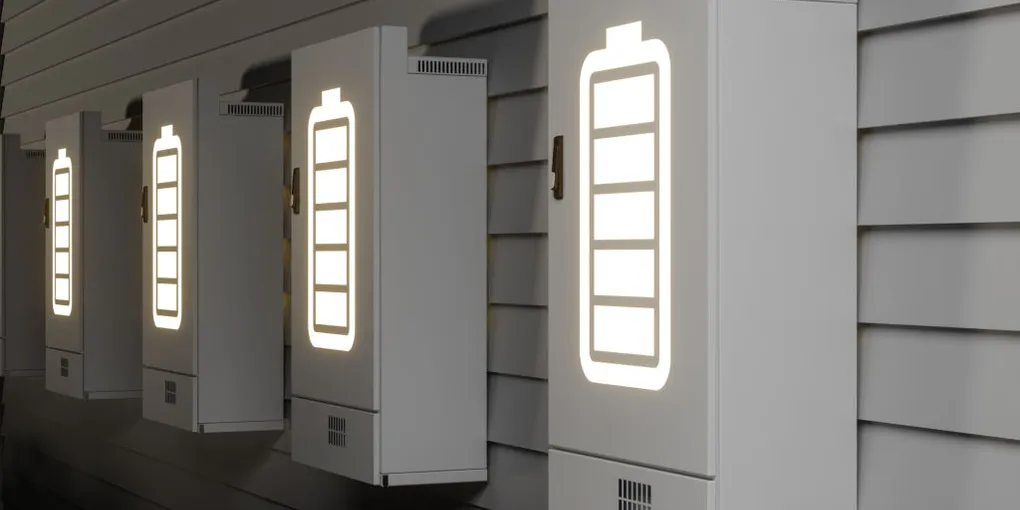
A home battery (Home Battery, ESS — Energy Storage System) is a stationary battery that stores electricity and delivers it on demand. The system consists of:
- Battery cells — the actual energy storage
- BMS (Battery Management System) — the electronic brain that monitors cell balance, temperature, charge/discharge currents
- Inverter/charger — converts current and manages energy flows between panels, battery, and home
- Enclosure — protection, cooling, mounting
By analogy: solar panels are the “electricity factory,” and the battery is the “warehouse.” During the day, the factory works and the warehouse fills up. At night, the factory is idle, but the house runs from the warehouse.
How It Works
Operating Modes
1. Self-Consumption During the day, solar panels power the home directly. Excess charges the battery. In the evening and at night, the home runs from the battery. Only what the panels and battery can’t cover is drawn from the grid.
2. Backup Power The battery stays fully charged and waits for a grid outage. During an outage, it instantly (within 10–20 ms) switches the home to battery power. Works like a “whole-house UPS.”
3. Time-of-Use Arbitrage Charge from the grid at night (when rates are low), discharge during the day (when rates are high). Relevant for regions with two- or three-tier tariffs.
4. Off-Grid (Full Autonomy) The battery is the only buffer between sources (panels, wind turbine, generator) and consumers. Requires maximum capacity and reliability.
Main Battery Types
| Type | Energy/Weight | Cycles | Depth of Discharge | Price per kWh | Lifespan |
|---|---|---|---|---|---|
| LFP (LiFePO₄) | 150–170 Wh/kg | 4,000–8,000 | 90–100% | $200–350 | 10–15 years |
| NMC (Li-ion) | 200–260 Wh/kg | 2,000–4,000 | 80–90% | $250–400 | 8–12 years |
| Lead-Acid (AGM) | 35–45 Wh/kg | 500–800 | 50% | $100–180 | 3–5 years |
| Gel | 35–45 Wh/kg | 600–1,000 | 50–60% | $120–200 | 4–6 years |
| Sodium-Ion | 120–160 Wh/kg | 3,000–5,000 | 90% | $150–250 | 8–12 years |
LFP (Lithium Iron Phosphate) — Best Choice for Home
LFP is the undisputed leader for home energy storage. Here’s why:
- Safety — doesn’t catch fire or explode when damaged (unlike NMC)
- Longevity — 4,000–8,000 cycles (10–15 years with daily charge/discharge)
- Deep discharge — you can use 90–100% of capacity without harming the battery
- Stable voltage — flat discharge curve
- Wide temperature range — from -20°C to +60°C
Example: a 10 kWh LFP battery with 6,000 cycles at daily use will last ~16 years. Cost of stored energy — about $0.04–0.06/kWh.
NMC (Nickel Manganese Cobalt)
Denser and lighter than LFP, but less safe. Used in early Tesla Powerwall generations. Requires BMS with temperature control. Higher round-trip efficiency but shorter lifespan.
Lead-Acid (AGM/Gel)
Cheap to buy but expensive to operate. Can only be discharged to 50%, otherwise they degrade rapidly. Heavy and bulky. Suitable only as a budget temporary solution.
For comparison: to store a usable 5 kWh, you need:
- LFP: 5.5 kWh battery (~35 kg)
- AGM: 10 kWh battery (~300 kg, because discharge is limited to 50%)
Sodium-Ion — Promising Newcomer
Contains no lithium, cobalt, or nickel. Cheaper to produce. Performance falls between LFP and lead-acid. CATL and BYD are already producing mass-market models. In 2–3 years, they may become an alternative to LFP for budget systems.
Advantages and Disadvantages of Home Batteries
Advantages:
- Energy independence — the house works during grid outages
- Maximum utilization of solar/wind energy (no wasted excess)
- Savings on peak tariffs (if your region has time-of-use rates)
- Silent operation
- Protection of sensitive equipment from voltage fluctuations
Disadvantages:
- High cost ($3,000–10,000 for 10 kWh)
- Limited lifespan (though LFP lasts 10–15 years)
- Conversion losses (round-trip efficiency 90–95%)
- Takes up space (a 10 kWh wall-mounted battery is approximately 60×80×20 cm)
- Requires proper disposal
Comparison of Popular Ready-Made Solutions
| Model | Capacity | Type | Power | Cycles | Price |
|---|---|---|---|---|---|
| Tesla Powerwall 3 | 13.5 kWh | LFP | 11.5 kW peak | 6,000+ | ~$9,500 |
| BYD Battery-Box HVS | 5.1–12.8 kWh | LFP | 5–12 kW | 6,000 | $4,000–8,000 |
| Pylontech US5000 | 4.8 kWh (stack.) | LFP | 4.6 kW | 6,000 | ~$1,800 |
| Huawei LUNA 2000 | 5–15 kWh | LFP | 5 kW | 6,000 | $4,500–10,000 |
| Growatt ARK | 5.1–17.9 kWh | LFP | 5 kW | 6,000 | $3,500–8,500 |
Pylontech US5000 — an excellent choice for a modular system. Batteries are stackable, and you can increase capacity as needed. Compatible with most hybrid inverters.
Practical Applications
Calculating Required Capacity
Step 1. Determine your home’s nighttime consumption (6 PM to 8 AM). Typically this is 30–50% of daily usage.
Step 2. For an average home consuming 10 kWh/day:
- Evening and nighttime consumption: ~6 kWh
- Reserve for cloudy days: +20–30%
- Recommended capacity: 8–10 kWh
Step 3. For full autonomy (off-grid) with a 2-day cloudy weather reserve:
- 10 kWh × 2 days = 20 kWh
- Recommended capacity: 20–25 kWh
Typical Wiring Diagram
Solar Panels → Hybrid Inverter → Battery + Home + Grid
The hybrid inverter is the key component. It manages energy flows:
- Panels → Home (priority)
- Panels → Battery (excess)
- Battery → Home (when panels aren’t producing)
- Grid → Home (when battery is depleted)
Recommended hybrid inverters:
- Victron MultiPlus-II — gold standard for off-grid, open ecosystem
- Huawei SUN2000 — excellent integration with LUNA batteries
- Growatt SPH — good price/performance ratio
- Deye SUN — popular budget option
Cost
Example: 10 kWh System for a Residential Home
| Component | Cost |
|---|---|
| LFP battery 10 kWh (e.g., 2× Pylontech US5000) | $3,500–4,000 |
| Hybrid inverter 5 kW | $1,200–2,500 |
| Switchboard, cables, protection | $300–600 |
| Installation and commissioning | $500–1,000 |
| Total | $5,500–8,100 |
Cost of stored energy over the entire lifespan:
- 10 kWh × 6,000 cycles = 60,000 kWh of throughput energy
- $6,000 / 60,000 = $0.10/kWh (including equipment)
Payback depends on the scenario:
- Tariff arbitrage (day/night difference $0.10): ~8–12 years
- Generator replacement ($0.30–0.40/kWh): ~3–5 years
- Off-grid (no alternative): payback is not the main criterion
How to Choose a Battery System
Selection Criteria
- Cell chemistry — LFP only for home use (safety + lifespan)
- Capacity — from 5 kWh (minimum for self-consumption) to 20+ kWh (off-grid)
- Discharge power — must cover peak home load (usually 3–5 kW, for electric stoves/water heaters — 7–10 kW)
- Modularity — ability to add capacity later
- Compatibility — with your inverter (check the compatibility list!)
- Warranty — minimum 10 years or 6,000 cycles
- BMS — active cell balancing, overheating protection, monitoring via app
What to Check Before Buying
- Inverter and battery compatibility — not all pairs work together. Check on the inverter manufacturer’s website
- System voltage — high-voltage (HV, 100–500V) is more efficient but more expensive. Low-voltage (48V) is simpler and safer for DIY
- Warranty conditions — what’s covered, whether certified installer is required
- Placement — indoor or outdoor, acceptable temperature range
Common Beginner Mistakes
-
Buying lead-acid batteries “because they’re cheaper.” Yes, AGM costs less per kWh at purchase. But over 10 years, you’ll replace them 2–3 times, ultimately spending 2x more than on LFP. And the actually usable capacity (at 50% DoD) is half the rated value.
-
Underestimating peak power. Capacity (kWh) is how much energy the battery stores. Power (kW) is how fast it delivers it. Kettle + microwave + pump = 5–7 kW. If the battery delivers a maximum of 3 kW — some appliances won’t start.
-
Installing in an unsuitable location. Lithium batteries don’t like frost (charging at t < 0°C is harmful). Don’t put batteries in an unheated garage if you live in a region with cold winters. Optimal: 10–25°C.
-
No monitoring. Without an app or web portal, you won’t see actual cycles, cell condition, or temperature. Modern BMS units (Pylontech, BYD, Huawei) have monitoring — use it.
-
DIY assembly from car cells without expertise. Building a battery from individual cells (e.g., EVE, CATL) can save 30–40%, but requires electronics knowledge, a quality BMS, and understanding of the risks. Without experience — go with a ready-made solution.
Future Developments
- Sodium-ion batteries — entering the mass market in 2025–2026. Cheaper than LFP, don’t require lithium. Ideal for stationary systems
- Solid-state batteries — higher energy density, higher safety. In commercialization stage, expected by 2028–2030
- Second-life EV batteries — spent electric vehicle batteries (70–80% remaining capacity) used as home storage at reduced prices
- Virtual Power Plants (VPP) — combining home batteries into a network to stabilize the power grid. Owners receive compensation for participation
- Falling prices — by 2028, LFP costs are expected to drop below $100/kWh, making home batteries widely accessible
FAQ
What battery capacity does a home need? To cover evening and nighttime consumption of an average home (8–12 kWh/day), a 10 kWh battery is sufficient. For full autonomy for 2 cloudy days — 20–25 kWh.
Can you use a car battery for home use? A regular starter battery — no. It’s designed for short-term high currents, not deep cycles. It degrades quickly. Deep-cycle traction batteries (AGM deep cycle) — yes, but LFP is still more cost-effective long-term.
Are lithium batteries dangerous? LFP (LiFePO₄) is the safest lithium chemistry. Not prone to thermal runaway. Doesn’t catch fire when damaged. NMC is less safe and requires temperature control. Only LFP is recommended for home use.
How long will a home battery last? LFP batteries: 10–15 years with daily charge/discharge cycles. Most manufacturers offer a 10-year or 6,000-cycle warranty. After the warranty expires, the battery doesn’t “die” — capacity simply decreases to 70–80%.
Should I wait for batteries to get cheaper? Prices are falling 10–15% per year. But if you’re already losing money on expensive electricity or suffering from outages — installing now will pay off faster than waiting for the “perfect price.”
Conclusion
A home battery is the key element of energy independence. Without a battery, solar panels only work during the day, and a wind turbine only works when there’s wind. With a battery, you control when and how you use the energy you produce. Choose LFP chemistry, calculate capacity based on your actual consumption, check compatibility with your inverter — and your home will become truly energy independent.